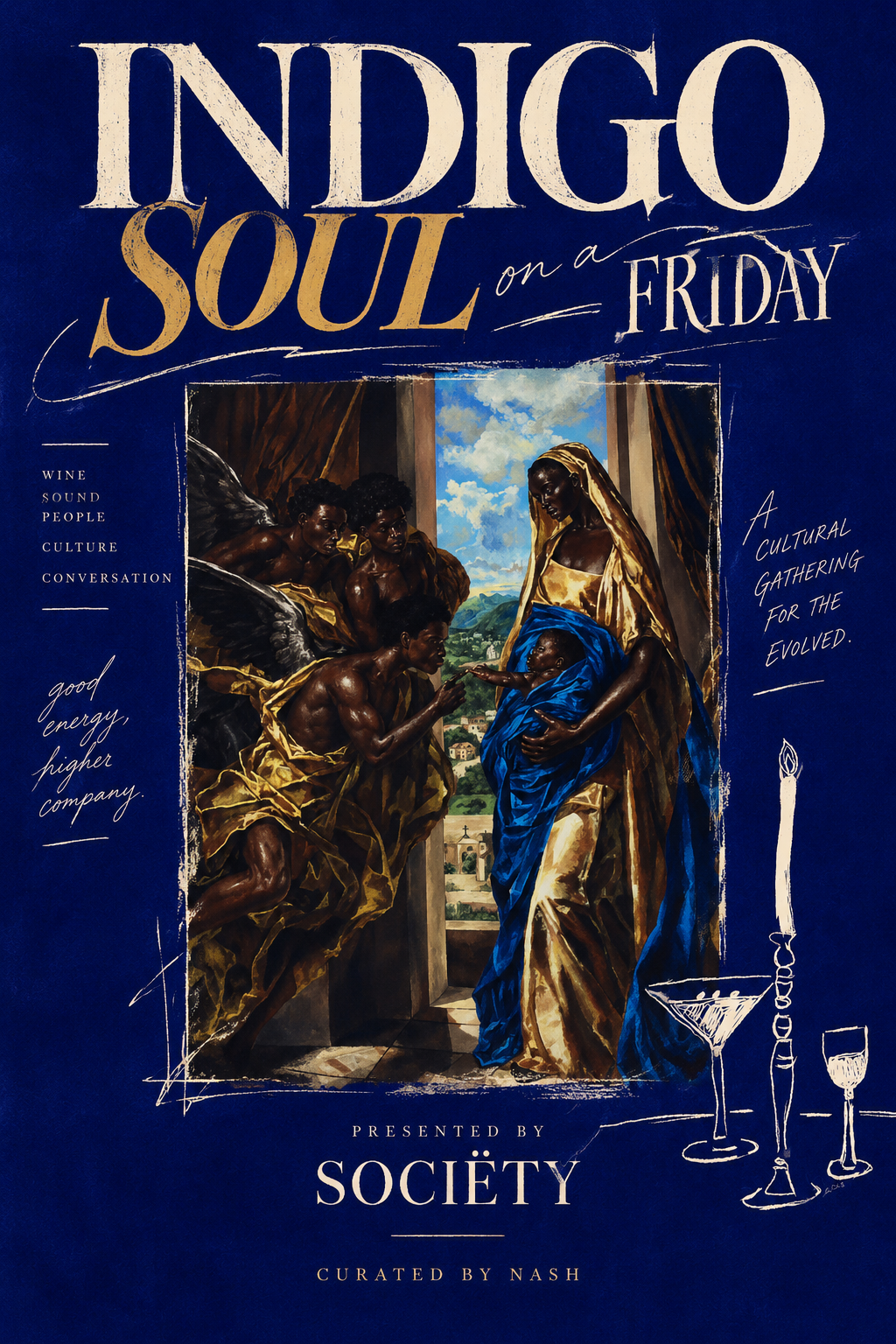
 Image 1 of 1
Admission: Members and registered guests only | 21+
Soul music was born in the church pews, tent revivals, and juke joints of the Deep South, shaped by people who turned hardship into some of the most powerful music in American history. Indigo in Blue is a listening, learning, and tasting experience that follows that story from gospel roots to the soul revolution.
Gospel Roots. We begin where it started: the Black church, the spiritual, and the call-and-response tradition. Sam Cooke’s years with the Soul Stirrers showed how gospel craft could cross into popular music.
The Architects of Soul
Ray Charles (born in Albany, Georgia) fused gospel melodies and feeling with rhythm and blues in the 1950s, a move that was controversial in the church and changed popular music.
James Brown (born in Barnwell, South Carolina, raised in Augusta, Georgia) emerged from gospel groups and built the rhythmic foundation of funk.
Aretha Franklin (born in Memphis, daughter of the preacher C.L. Franklin) carried gospel in her voice, and her 1972 live album Amazing Grace, recorded in a Los Angeles church, remains a landmark.
Al Green (born in Forrest City, Arkansas) brought silky, spiritual intimacy to the Memphis sound, later becoming a pastor himself.
The Sounds of Memphis. Stax Records, with Booker T. & the M.G.’s and Otis Redding of Dawson, Georgia, and Hi Records, with producer Willie Mitchell, gave Memphis a gritty and a smooth soul sound, built in studios that were often racially integrated at a time when the surrounding South was not.
Progressive Soul. As the civil rights era deepened, artists like Curtis Mayfield, Marvin Gaye, Nina Simone, Donny Hathaway, and Stevie Wonder moved soul toward social commentary, storytelling, and experimentation, using the music to speak directly about justice, community, and change.
A guided whiskey tasting runs alongside the music, with each pour paired to an era or artist. We’ll also trace the often-overlooked Black history of American whiskey, including Nearest Green, the formerly enslaved distiller widely credited with teaching a young Jack Daniel, and how that story connects to the culture and craft the music grew from.
Tasting flight, pairing notes, and non-alcoholic option details: [to be confirmed].
Curated listening sessions with historical context
A guided whiskey flight with tasting notes and cultural storytelling
Conversation on how music, faith, resistance, and craft shaped a nation
Connection with fellow members in an intimate setting